Unblocking Your Microsoft 365 Copilot Rollout: How to Define Success and Drive Real ROI

Gartner’s research reveals a persistent “AI intention gap.” Each year from 2019 to 2024, roughly ...



Microsoft 365 Copilot adoption is accelerating across enterprises. The business case often sounds straightforward: improved productivity, faster content creation, reduced manual work, and better decision support.
Yet many organizations struggle to answer a simple question six months after deployment:
Is Copilot actually improving performance and the outcomes you were hoping to achieve?
This is ultimately a Microsoft Copilot success metrics problem, not necessarily a technology problem.
Imagine being handed a 1,000-piece puzzle without the image on the box. You can start assembling pieces, but without knowing what the finished picture should look like, you cannot determine whether you are making progress.


Copilot deployments often follow the same pattern during early Copilot deployment phases. Licenses are activated. Users begin experimenting. Activity increases. But without clearly defined success criteria and baseline metrics, organizations lack an objective reference point for evaluating impact.
The issue is rarely technology. It is the absence of a structured Copilot adoption framework for measuring success.
Research shows that unclear or poorly defined success criteria are one of the leading causes of project failure. Here are the key statistics:
Copilot initiatives are also subject to these patterns. Without a clear Copilot adoption strategy, organizations risk falling into the same confusion that hampers other transformation efforts. So, with all these obstacles, how can you become one of the 30% of projects that succeed?
Copilot cannot be evaluated by license activation or prompt usage alone. A structured Copilot adoption strategy requires performance metrics that connect collaboration patterns, delivery performance, operational quality, and business outcomes.
This article outlines a practical four-layer framework for measuring Microsoft Copilot success in a way that is defensible, operationally grounded, and aligned to executive expectations.
I’ve seen a few scenarios play out at companies I’ve worked with. Far too often, the motivation to adopt Copilot stemmed from one of two situations:
In both scenarios, the core issue is not ambition. It is ambiguity.
When expectations are shaped by external narratives rather than defined operational goals, organizations move forward without clearly articulating what success should look like inside their own environment.
Many Copilot initiatives begin with enthusiasm and broad expectations:
These statements are directionally correct but operationally vague.
Without clearly defined metrics and baseline data, organizations default to active licenses and assumptions rather than structured Copilot impact measurement.
When organizations approach Copilot strategically, their objectives are specific and measurable. For example:
Sales and Revenue
Collaboration and Productivity
Employee Experience
Customer Support
Engineering and Content
These outcomes are materially different from broad productivity claims. They define where impact should occur and create the foundation for measurable evaluation.
Defining outcomes at this level of specificity is the prerequisite to measurement. Once objectives are clearly articulated, the next step is to establish baseline metrics across four performance layers.
Once success outcomes are clearly defined, the next step is to understand where you stand today. You cannot measure progress without first documenting your current state.
Before enabling Copilot broadly, create a structured baseline grid that captures what you are measuring and how you are measuring it.
Your Copilot baseline metrics documentation might look like this:
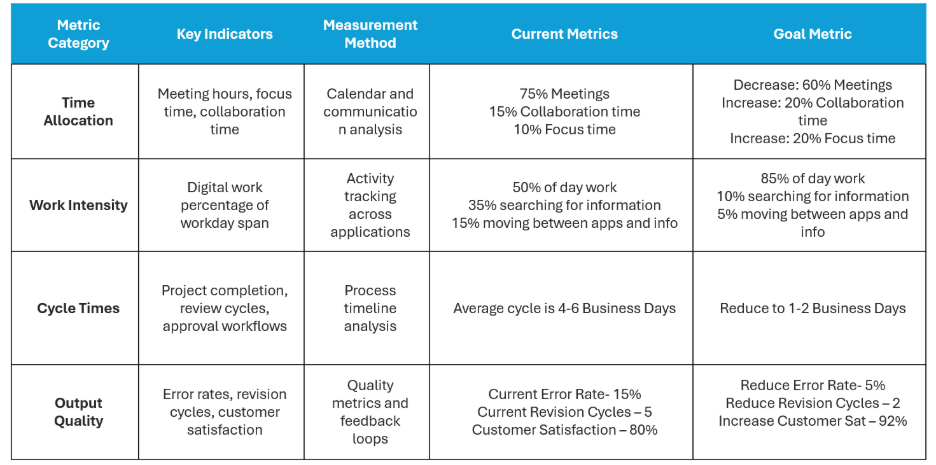
This structured approach ensures that every Copilot objective is tied to a measurable starting point.
Capturing baseline metrics before Copilot deployment provides the clearest comparison over time. However, even if deployment has already begun, documenting current state performance can still create a meaningful reference point for future evaluation.
For each metric, it can also be helpful to document:
Standardization is critical. If metric definitions shift after rollout, comparisons can lose credibility.
Organizations should also define exclusions and segmentation rules up front. For example:
Baseline discipline enables meaningful executive reporting later and prevents disputes about methodology once the Copilot ROI impact is under review. Without baseline data, proving Microsoft Copilot ROI becomes speculative rather than defensible.
Microsoft 365 Copilot directly influences how employees collaborate, prepare for meetings, draft communications, and process information.
Before and after deployment, organizations should evaluate:
For Microsoft 365 environments, collaboration telemetry can be analyzed through Microsoft tools such as Viva Insights, and third-party tools like ENow’s True Adoption Center for Copilot. Google Workspace, Slack, and Zoom environments provide similar org-level insights and activity indicators.
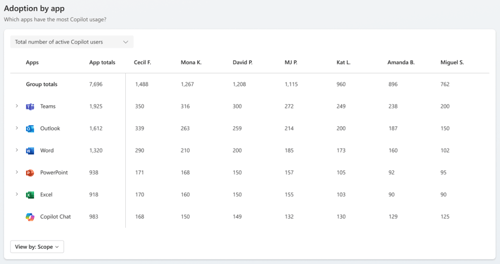 Figure 1. The Copilot Adoption Dashboard showing the amount of Copilot usage by app.
The goal is not to reduce collaboration indiscriminately. It is to determine whether Copilot meaningfully changes:
If collaboration load remains constant, but delivery performance improves, Copilot may be accelerating output without reducing meeting time. That insight can inform your licensing and enablement strategy.
For engineering, product, and project teams, Copilot may influence how quickly work moves from idea to completion.
Baseline and track:
Tools such as Jira (Atlassian) and Azure DevOps provide structured delivery metrics. DORA metrics offer standardized performance benchmarks across engineering organizations.
The key question at this layer is:
Is Copilot improving throughput, reducing rework, or shortening feedback loops?
If delivery metrics remain unchanged, Copilot may be assisting individuals but not shifting systemic performance. That distinction matters at scale.
These delivery metrics are essential Copilot performance metrics for engineering and product organizations. The same discipline should apply across collaboration and service layers to ensure comprehensive Copilot performance metrics coverage.
Within IT, service, and operational functions, Microsoft Copilot is often introduced to streamline high-volume tasks such as knowledge retrieval, case summarization, response drafting, and root cause documentation. Measuring Copilot service impact requires tracking both efficiency and quality metrics.
While these capabilities can reduce manual effort, operational success must be measured across both efficiency and quality indicators.
Before deployment, establish baselines across core service metrics, including:
Platforms such as ServiceNow, Salesforce Service Cloud, and DevOps/DORA dashboards provide structured views into these KPIs. Many organizations leverage GitHub or Azure DevOps integrations to track change failure rate and MTTR as indicators of operational stability.
Beyond speed-based metrics, organizations should also monitor revision cycles and rework trends. If Copilot accelerates drafting but increases documentation errors or change rejections, overall operational quality may decline despite faster activity.
Customer feedback platforms such as Qualtrics or SurveyMonkey add another layer of insight. Customer Satisfaction (CSAT) measures transactional quality at the case level, while Net Promoter Score (NPS) reflects broader relationship health.
Finally, trend analysis matters. Performance dashboards should evaluate stability over time, not just point-in-time improvement. Predictive analytics and variance tracking can help identify whether Copilot introduction correlates with sustained improvement or unintended volatility.
Operational integrity must remain stable or improve as AI-assisted workflows are introduced.
When measured correctly, this layer answers a critical executive question: Is Copilot helping us resolve issues more effectively, or simply faster?
Copilot success should ultimately connect to measurable business outcomes. This is where Microsoft Copilot ROI becomes visible at the executive level.
Depending on function, this may include:
This layer prevents the common trap of measuring internal efficiency without tying improvements to organizational objectives.
For example:
If those connections are not visible, Copilot impact may be isolated rather than systemic.
Copilot measurement should not be rigid or one-dimensional. Organizations require flexibility in how they evaluate usage and performance impact.
At the executive level, aggregated reporting provides visibility into overall adoption trends, operational impact, and ROI alignment.
At the department or team level, more granular insights may be necessary to:
Different roles require different levels of visibility. A CIO may need enterprise-level performance summaries, while a department head may need team-level or user-level insight to drive outcomes.
The key is establishing clear governance around how data is used and ensuring reporting aligns with organizational policies and culture.
Measurement should be adaptable, role-based, and purpose-driven.
Flexibility allows organizations to balance performance management, adoption acceleration, and compliance without limiting their ability to evaluate Copilot impact effectively.
Organizations can undermine Copilot success measurement by:
A structured framework reduces noise and keeps reporting focused on measurable improvement.
Copilot adoption is often framed as a productivity initiative. In reality, it is a performance transformation initiative.
The difference lies in measurement.
When organizations evaluate Copilot using structured success metrics across collaboration, delivery, operational quality, and business outcomes, they move from anecdotal enthusiasm to defensible performance improvement and Copilot ROI.
That shift enables:
Copilot is not successful because it is purchased and activated.
It is successful when measurable operational outcomes improve.
In our next article, we will explore how to translate this measurement framework into structured change management that drives sustainable adoption.
Until Then-
Stephen
Operationalizing this four-layer model requires consolidated visibility across governance, usage analytics, and ROI tracking.
ENow’s Copilot Center centralizes these insights into a unified dashboard designed for IT leaders responsible for secure Microsoft Copilot adoption and measurable business impact.


Gartner’s research reveals a persistent “AI intention gap.” Each year from 2019 to 2024, roughly ...